Cost · 7 min read
How much does a custom wig cost in the UK?
By GlobalHairSystems.com · Updated 16 September 2026
How much does a custom wig cost in the UK?
A custom full wig in the UK costs £940 to £2,180, set by cap construction, hair type and density rather than location. Consultation, head measurement and hair matching are free, with a 12 to 15 day turnaround from a confirmed template. Human hair costs more than synthetic but styles and lasts noticeably better.
Key figures
- A custom full wig in the UK costs £940 to £2,180, driven by cap construction and hair grade rather than city.
- Human hair wigs cost more than synthetic but survive 10 to 18 months of regular wear against 4 to 8 for synthetic.
- Consultation, an eight-point head measurement and hair matching are free with every order.
- Turnaround for a fully custom wig runs 12 to 15 days from a confirmed template.
- A second, shorter-length cap for everyday wear typically adds a further £700 to £1,200 to the first-year spend.
- A full wig is over-specified, and overpriced, for anyone who still has usable anchor hair around the sides and back.
A custom wig is the biggest single purchase on our price list, and the question we hear most is why the range runs as wide as £940 to £2,180 for what looks, on paper, like one product. The answer is that a wig is really two decisions stacked together — how the cap is built and what hair goes into it — and both move independently. This guide sets out what actually drives the number, what's included at no extra cost, how long the order takes, and when a full wig is more coverage than you need.
What drives the £940–£2,180 range
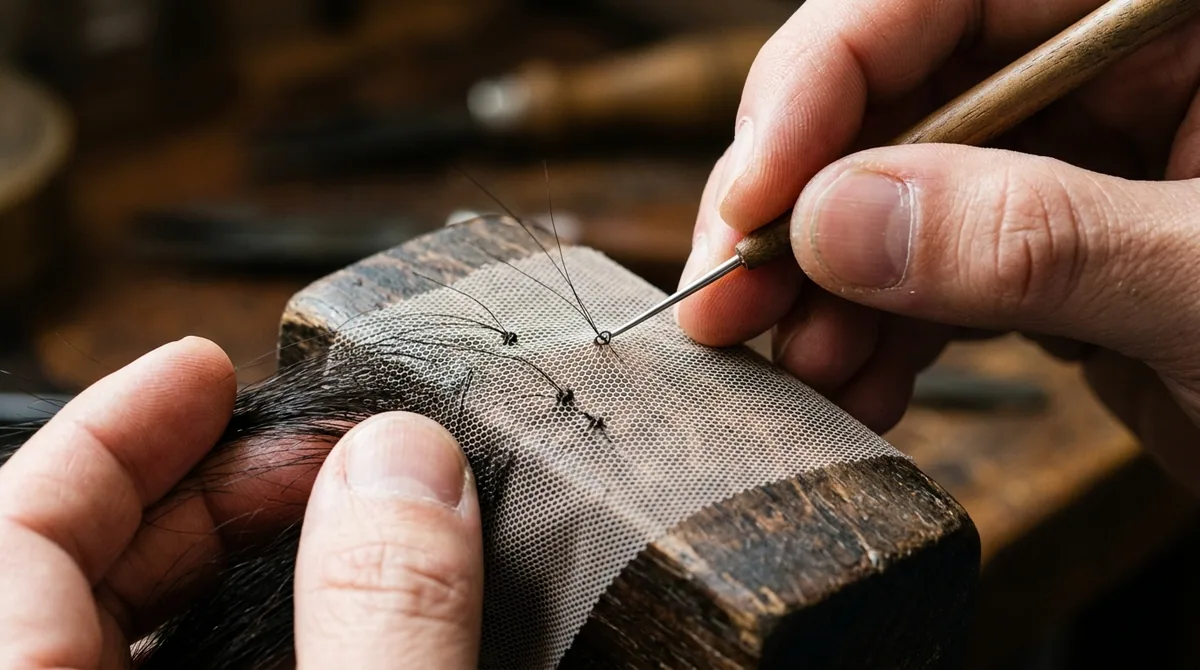
The spread exists because a wig is priced on two separate decisions, not one. Cap construction is the first: a machine-wefted or partial-lace cap sits toward the lower end of the range, while a full hand-tied lace or silk-top cap, knotted strand by strand for a natural parting, sits toward the top. The second is the hair itself — density, texture, and above all human hair against synthetic — and that decision alone can move the price by several hundred pounds either way.
Head shape and any scalp sensitivity also factor in, particularly for anyone ordering after hair loss from treatment, where a soft, seam-free interior is worth paying for even though it doesn't show. None of this is negotiable by studio or region — the range holds across the UK because there's no city premium on the unit itself, only on how it's built.
- Cap construction: machine-wefted and partial lace toward £940–£1,300; full hand-tied lace or silk-top toward £1,600–£2,180
- Hair: human hair costs more than synthetic but takes heat styling and lasts far longer
- Density and parting: a hand-tied parting that mimics scalp costs more to knot than a uniform-density cap
Human hair or synthetic — which is worth the extra
Synthetic hair holds its set through weather a human-hair cap will not, which sounds like an advantage until you try to style it — synthetic fibre can't take heat, so a fringe or parting cut for one look stays that way until the cap is replaced. It also tends to develop a slight shine after a few months of regular washing and UV exposure that's hard to miss up close, and colour options are more limited than a hand-tinted human-hair cap allows.
Human hair costs more up front but takes a straightener or dryer the same way your own hair would, and a well-maintained human-hair cap lasts 10 to 18 months of daily wear against roughly 4 to 8 for synthetic. For anyone wearing a wig every day rather than occasionally, the per-month cost usually favours human hair once you account for the shorter synthetic replacement cycle.
What's included at no extra cost
Every wig order starts with a free consultation and an eight-point head measurement, so the cap is built to your head rather than a generic size that needs padding to fit. Hair matching — colour, texture and grey percentage against your own sample — is also free, and happens before anything is cut or ordered, which is what stops a finished cap arriving a shade off your own hair.
None of this changes whether you're ordering for pattern hair loss, alopecia, or hair loss during cancer treatment. The only genuine add-on most clients choose is a second cap, usually a shorter, lower-maintenance length for everyday wear while a longer cap is kept for occasions — that second cap is priced as a separate unit, typically £700 to £1,200 depending on construction.
Turnaround and ordering timeline
From a confirmed template, a fully custom wig takes 12 to 15 days to build, since every cap is hand-knotted rather than pulled from stock. If you're ordering ahead of chemotherapy, the honest advice is to order while you still have your own hair to match against — colour, density and grey percentage are all easier to get right from the real thing than from a photograph taken afterwards.
There's no rush option that skips the template stage — the cap has to sit correctly on your head before knotting starts, and a wig built to the wrong measurement can't be corrected afterwards the way a smaller repair can. Booking a consultation a few weeks ahead of any deadline, whether that's a treatment start date or an event, keeps the timeline comfortable rather than tight.
First-year cost of owning a wig
A wig's running cost is lower than a bonded hair system's, because nothing is glued to the scalp and there's no re-bonding schedule to keep. The main ongoing costs are washing products safe for the cap, occasional re-styling, and — for most daily wearers — a second cap on rotation so one is always dry and ready while the other airs.
The table below sets out a realistic first year for a single-cap household and a two-cap rotation, using the unit price range set out above and typical product spend rather than a padded worst case. Most daily wearers move to the two-cap route once they've lived with a single cap for a few months and felt how much drying time it genuinely needs between wears.
| Item | Single cap | Two-cap rotation |
|---|---|---|
| Unit (cap, custom) | £940 – £2,180 | £1,880 – £3,380 |
| Cap-safe washing & styling products, 12 months | £120 – £240 | £180 – £360 |
| Occasional re-styling / trim | £40 – £120 | £60 – £180 |
| Year-one total | £1,100 – £2,540 | £2,120 – £3,920 |
When a wig is the wrong purchase
A full wig is more coverage than most clients need. If you still have hair around the sides and back strong enough to anchor a clip, a topper or a smaller hair system does the same job for less money, weighs less, and runs cooler day to day — you'd be paying for a full cap to replace hair that's still there.
It's also the wrong order to place mid-treatment if you're losing hair to chemotherapy. Once your own hair has gone, we're matching colour and density from a photograph rather than the real thing, and the result is always an approximation. Ordering before treatment starts, while there's still hair to sample, gets a noticeably closer match, and a shorter, everyday second cap can always be added later once you know how you want to wear it day to day.
The figures on this page
Every number below comes from systems we build, fit, service and repair ourselves. Reuse with attribution to GlobalHairSystems.com is welcome.
- Custom full wig, unit price
- £940 – £2,180
- Human hair cap lifespan
- 10–18 months
- Turnaround, fully custom order
- 12–15 days
- Second cap (rotation)
- £700 – £1,200
Set by cap construction and hair type, not by which part of the UK the order is placed from.
With daily wear and proper washing; synthetic caps last roughly 4–8 months under the same use.
Measured from a confirmed template to a finished, fitted cap.
Typically a shorter, lower-maintenance length kept for everyday wear.
Definitions
- Cap construction
- How a wig's base is built — commonly machine-wefted, partial lace, full lace or silk-top — which determines how natural the parting looks and how much the cap costs to make.
- Hand-tied parting
- A parting knotted strand by strand into a lace or silk base so individual hairs appear to grow from the scalp, rather than lying in a machine-sewn weft.
- Eight-point head measurement
- A fitting method that records eight reference points around the skull, used to build a wig cap that grips securely without a chin strap or excess padding.
- Two-cap rotation
- Keeping two wigs in regular use so one is always dry and rested while the other is worn, extending the life of both caps.